
绅士的品格
Chinese firm’s Lixun-1 ‘space tug’ eyes maiden flight in Q1 2027 after key propulsion tests_我的网站

A |
[ 购车手册] 当我们现在调侃“马路三大妈”时,还记得它们的对立面——百米(这里其实应该是零百加速,为了押韵)加速三王侯:君威(参数|询价)CC蒙迪欧。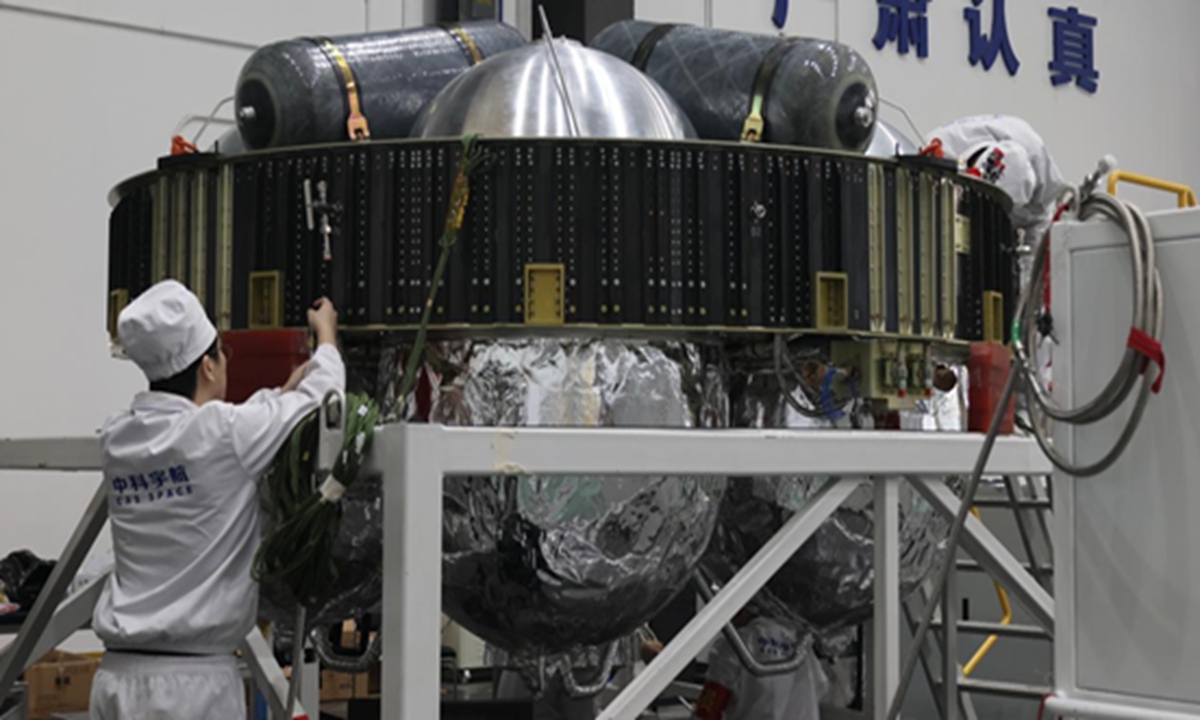
Lixun-1 upper stage, a versatile "space tug" developed by China's commercial space firm CAS Space, is scheduled to make its maiden flight in the first quarter of 2027 after completing a series of key propulsion-system tests, the developer and its chief designer told the Global Times on Tuesday.
The "tug" is designed to ferry satellites from one orbit to another and support missions ranging from constellation deployment to lunar exploration.
While the main stages of a rocket carry payloads from the ground into an initial orbit, an upper stage takes over once the craft is in space. By repeatedly restarting its engine and changing orbit, Lixun-1 can deliver satellites to higher or different orbits, distribute multiple spacecraft to separate destinations during a single launch, or send probes onto trajectories toward the moon and beyond, Global Times learned from the developer.
Yang Haoliang, chief designer of the Lixun-1 upper stage, compared the system to a shuttle service. "If the regular stages of a launch vehicle are like a long-distance bus," - they carry the upper stage and satellites from Earth to a near-Earth parking orbit - the upper stage then takes over as a "space tug," carrying its satellite "passengers" onward to their designated orbital "stops," Yang explained.
That capability can have a direct impact on how efficiently satellites are launched and operated, Yang said. If a satellite has to climb from an initial orbit to its final destination using its own engine, the process can consume a considerable amount of onboard propellant and reduce the fuel available during its operational life. An upper stage can instead perform that orbital transfer, helping conserve satellite fuel and potentially extend its service life.
It can also make one rocket launch do more work. Instead of releasing a batch of satellites into roughly the same orbit, Lixun-1 can repeatedly ignite its engine and maneuver between deployments, sending different satellites to different altitudes and inclinations. Yang said this would help accelerate constellation deployment while improving the efficiency of individual launches.
The practical ambitions behind the system are backed by a major technical milestone reached this month. In August, Lixun-1 completed its PV-001 integrated propulsion-system coordination firing test, during which the entire system operated smoothly for 566 seconds.
Yang told the Global Times that the current Lixun-1 upper stage has a thrust of 20 kilonewtons and can achieve a specific impulse of 315 seconds, which he described as reaching an internationally leading level. The August firing covered the planned profile for the maiden mission, an important step before the system proceeds to flight testing.
The test was more than a demonstration of the engine itself. As an important system-level verification during development, it examined the coordination and engineering reliability of the engine pressurization system, propellant delivery system, propellant management system and servo-control system under the fully integrated configuration.
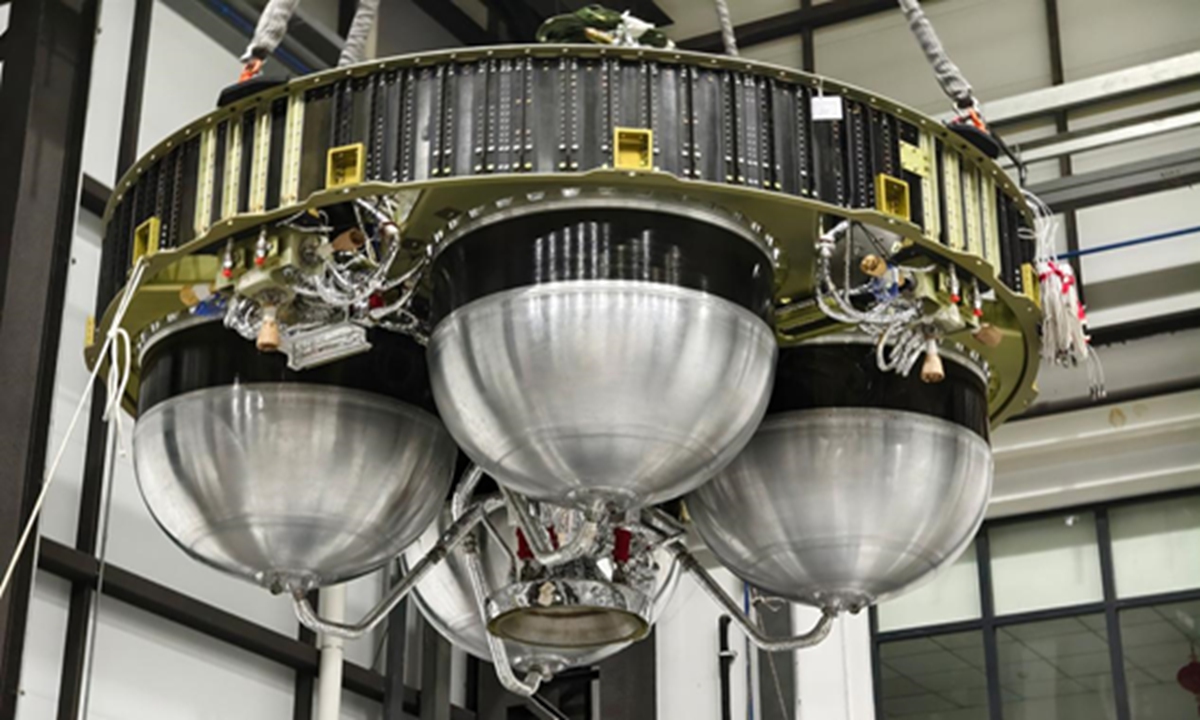
Of a series of tests that accumulated 5,211 seconds of firing time, the latest one focused on three core technologies: a high-thrust, high-performance 20-kilonewton upper-stage engine capable of multiple starts; balanced propellant delivery from multiple parallel tanks; and a highly reliable integrated electrical system. Their successful verification means Lixun-1 has completed its system-level testing and is ready to move into the flight-test phase, according to the developer.
Lixun-1 has been designed as a modular and generally adaptable upper stage rather than a system tied to only one rocket. It is intended to work with CAS Space's Kinetica-2 and Kinetica-2 heavy-lift variants as well as other launch vehicles, Yang said.
When paired with the Kinetica-2 family, Lixun-1 could significantly expand the rocket's mission range. For communications missions, it could deliver satellites to geosynchronous transfer orbit or even directly to geosynchronous orbit, conserving satellite propellant while supporting the deployment of high-throughput satellites and future 6G communications spacecraft.
For multi-satellite missions, the combination could distribute spacecraft to different orbital altitudes and inclinations during a single launch, potentially serving both low-Earth-orbit constellations and medium- or high-orbit payloads. For deep-space missions, it could place probes onto Earth-moon transfer trajectories and support lunar exploration, Yang said.
The upper stage is designed to be able to conduct more than 20 engine ignitions, autonomously plan orbital-transfer routes and operate under the vacuum and extreme temperature conditions of space. After completing payload deployment, it can also carry out orbital disposal maneuvers to reduce space-debris risks.
Yang said the Lixun-1 and Kinetica-2 combination is designed to cover the vast majority of commercial satellite launch requirements while retaining the ability to participate in major national space projects. More broadly, the upper stage forms part of CAS Space's effort to build launch capabilities reaching medium and high Earth orbits and deep space, extending the reach of China's commercial space sector toward higher orbits and more distant destinations.
。至于别克君威,就是今天的主角,这次要聊的不是运动车型,而是它的性价比。首先,你需要重新建立你的价格体系了,一台合资中型车你猜能卖到啥价格?
。
B | 可惜当年的风光已不再,马路上很少能看到最美大众轿跑的身影,蒙迪欧也早已没有当年大嘴马丁的风范,可见这些以动力和操控见长的车型,日子并不好过。
Lixun-1 upper stage, a versatile "space tug" developed by China's commercial space firm CAS Space, is scheduled to make its maiden flight in the first quarter of 2027 after completing a series of key propulsion-system tests, the developer and its chief designer told the Global Times on Tuesday.
The "tug" is designed to ferry satellites from one orbit to another and support missions ranging from constellation deployment to lunar exploration.
While the main stages of a rocket carry payloads from the ground into an initial orbit, an upper stage takes over once the craft is in space. By repeatedly restarting its engine and changing orbit, Lixun-1 can deliver satellites to higher or different orbits, distribute multiple spacecraft to separate destinations during a single launch, or send probes onto trajectories toward the moon and beyond, Global Times learned from the developer.
Yang Haoliang, chief designer of the Lixun-1 upper stage, compared the system to a shuttle service. "If the regular stages of a launch vehicle are like a long-distance bus," - they carry the upper stage and satellites from Earth to a near-Earth parking orbit - the upper stage then takes over as a "space tug," carrying its satellite "passengers" onward to their designated orbital "stops," Yang explained.
That capability can have a direct impact on how efficiently satellites are launched and operated, Yang said. If a satellite has to climb from an initial orbit to its final destination using its own engine, the process can consume a considerable amount of onboard propellant and reduce the fuel available during its operational life. An upper stage can instead perform that orbital transfer, helping conserve satellite fuel and potentially extend its service life.
It can also make one rocket launch do more work. Instead of releasing a batch of satellites into roughly the same orbit, Lixun-1 can repeatedly ignite its engine and maneuver between deployments, sending different satellites to different altitudes and inclinations. Yang said this would help accelerate constellation deployment while improving the efficiency of individual launches.
The practical ambitions behind the system are backed by a major technical milestone reached this month. In August, Lixun-1 completed its PV-001 integrated propulsion-system coordination firing test, during which the entire system operated smoothly for 566 seconds.
Yang told the Global Times that the current Lixun-1 upper stage has a thrust of 20 kilonewtons and can achieve a specific impulse of 315 seconds, which he described as reaching an internationally leading level. The August firing covered the planned profile for the maiden mission, an important step before the system proceeds to flight testing.
The test was more than a demonstration of the engine itself. As an important system-level verification during development, it examined the coordination and engineering reliability of the engine pressurization system, propellant delivery system, propellant management system and servo-control system under the fully integrated configuration.
Of a series of tests that accumulated 5,211 seconds of firing time, the latest one focused on three core technologies: a high-thrust, high-performance 20-kilonewton upper-stage engine capable of multiple starts; balanced propellant delivery from multiple parallel tanks; and a highly reliable integrated electrical system. Their successful verification means Lixun-1 has completed its system-level testing and is ready to move into the flight-test phase, according to the developer.
Lixun-1 has been designed as a modular and generally adaptable upper stage rather than a system tied to only one rocket. It is intended to work with CAS Space's Kinetica-2 and Kinetica-2 heavy-lift variants as well as other launch vehicles, Yang said.
When paired with the Kinetica-2 family, Lixun-1 could significantly expand the rocket's mission range. For communications missions, it could deliver satellites to geosynchronous transfer orbit or even directly to geosynchronous orbit, conserving satellite propellant while supporting the deployment of high-throughput satellites and future 6G communications spacecraft.
For multi-satellite missions, the combination could distribute spacecraft to different orbital altitudes and inclinations during a single launch, potentially serving both low-Earth-orbit constellations and medium- or high-orbit payloads. For deep-space missions, it could place probes onto Earth-moon transfer trajectories and support lunar exploration, Yang said.
The upper stage is designed to be able to conduct more than 20 engine ignitions, autonomously plan orbital-transfer routes and operate under the vacuum and extreme temperature conditions of space. After completing payload deployment, it can also carry out orbital disposal maneuvers to reduce space-debris risks.
Yang said the Lixun-1 and Kinetica-2 combination is designed to cover the vast majority of commercial satellite launch requirements while retaining the ability to participate in major national space projects. More broadly, the upper stage forms part of CAS Space's effort to build launch capabilities reaching medium and high Earth orbits and deep space, extending the reach of China's commercial space sector toward higher orbits and more distant destinations.
。至于别克君威,就是今天的主角,这次要聊的不是运动车型,而是它的性价比。首先,你需要重新建立你的价格体系了,一台合资中型车你猜能卖到啥价格?

C | (君威GS改装套件适用于2024款及后续君威车型,包括焕新前保、曜黑中网、“獠牙”之刃和极夜后扰流板)。

D |
目前在售的君威车型配有1.5T和2.0T两款发动机,1.5T最大功率169马力,峰值扭矩250牛·米,2.0T最大功率237马力,峰值扭矩350牛·米,匹配的都是9速手自一体变速箱。从动力上来说1.5T代步够用,推动这台1.4吨左右的君威并无压力,中等的油门深度下输出足够轻快和积极,只不过大油门深度下,发动机的声音和振动会传递到车内一部分,影响NVH表现。从横向角度,德系和日系的1.4T/1.5T这种小排量版本,也是主销车型,入门价格更低,油耗上也优势。2.0T就能给予较强的加速感,但性价比不如1.5T车型,适合对动力要求较高的用户。9AT变速箱的标定逻辑偏向于经济,以升挡积极来换取更低的油耗。转向阻尼会根据驾驶模式,切换SPORT模式会进一步加重,以运动车的标准来衡量的话,这台车的表现还欠些火候,但如果以一台中型轿车的标准来衡量它的运动性,那我觉得驾驶起来有一定乐趣。
E |
Current article:http://2yvd.sunmougadangwaizhuimi.bond/list_la3uke/r1d.html
Published on:15:04:00